
Introduction to EMC and EMI: A Practical Guide to Electromagnetic Compatibility
Introduction to EMC & EMI
A Practical Guide to Electromagnetic Compatibility
1. What Is EMC?
Electromagnetic compatibility — or EMC — refers to an electronic device's ability to work correctly in its electromagnetic environment without causing problems for other nearby equipment. Think of it as being a good neighbor in the electromagnetic spectrum: your device needs to stay quiet without disturbing others, while also being tough enough to handle the electromagnetic "noise" around it.
Every electronic product exists in an invisible sea of electromagnetic energy. Radio waves, cell phone signals, Wi-Fi networks, and countless other devices are constantly generating electromagnetic fields. An EMC-compliant product must achieve two goals:
- Low emissions — It must keep its own electromagnetic output low enough to avoid interfering with other devices.
- High immunity — It must be able to keep functioning correctly even when exposed to electromagnetic disturbances from the environment around it.
2. EMC vs. EMI — What's the Difference?
EMC and EMI are related but not the same thing. EMI (electromagnetic interference) is the problem — it's what happens when one electronic device causes unwanted disturbances to another device nearby. EMC is the solution — it's the design and testing process that prevents EMI from happening in the first place.
EMC EMI The goal — designing products to prevent interference. The problem — unwanted disturbance between devices. A standard your product is tested against. An event that happens when EMC is not addressed. Prevents EMI before it reaches the real world. The consequence of poor electromagnetic design.
In short: EMC testing during development is what ensures EMI won't become a problem when your product is out in the field.
3. Why EMC Matters More Than You Think
Meeting regulatory requirements is important, but EMC goes far beyond checking boxes. Electromagnetic interference can be genuinely dangerous — not just an annoyance.
Real-World Incidents
In 1992, a woman lost her life when an ambulance's heart monitor repeatedly shut down every time technicians activated their radio transmitter. In 1994, a Texaco refinery explosion in Milford Haven, UK, was triggered by power surges from an electrical storm. The blast injured 26 people and caused £48 million in damage. These are not isolated cases — they represent just a fraction of EMC-related failures that have caused real harm.
Taking EMC seriously is about creating safer products, protecting users, ensuring reliability, and building trust. When your product works flawlessly regardless of its electromagnetic environment, everyone benefits.
4. Emissions — Controlling What Your Device Puts Out
Emissions are the electromagnetic signals your device generates. There are two main types: conducted emissions (which travel along cables) and radiated emissions (which broadcast into the air).
4.1 Conducted Emissions
These are disturbances that travel along the cables connected to your device. There are three key areas that get tested:
- RF Conducted Emissions — This test ensures your cables don't act as antennas and radiate interference to nearby equipment. Commercial and industrial products are typically tested from 150 kHz to 30 MHz. Military and defense applications extend that range dramatically — from 30 Hz all the way up to 40 GHz.
- Harmonic Emissions — Many devices don't draw current as a smooth sine wave. Instead, they inject harmonic currents back into the power grid. Standards exist to limit these harmonics and keep the power supply clean for everyone on the same network.
- Flicker — This covers voltage fluctuations that cause visible changes in lighting brightness. It happens when a device draws rapidly varying amounts of current. Testing makes sure your product won't cause annoying or harmful flicker in nearby lighting systems.
4.2 Radiated Emissions
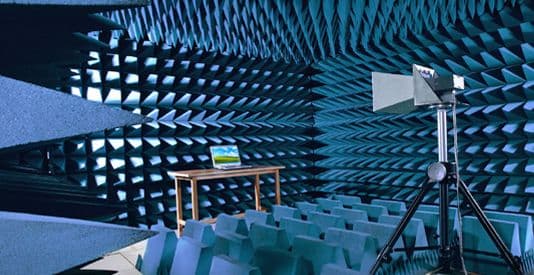
Radiated emissions are electromagnetic fields that broadcast directly from your product into the surrounding environment. These are measured in specialized test chambers — either anechoic or semi-anechoic — or at open-area test sites.
Typical Frequency Ranges
Commercial & industrial equipment is usually tested from 30 MHz to 6 GHz, though some standards push up to 40 GHz. Military and defense products face even stricter requirements, with testing spanning from 10 kHz to 40 GHz.
5. Immunity — Withstanding Outside Interference
Just as your product must keep its own emissions in check, it also needs to keep working when the outside world throws electromagnetic disturbances at it. Immunity testing covers both cable-borne and airborne interference.
5.1 Conducted Immunity
These tests simulate disturbances that arrive through your product's cables:
- RF Conducted Immunity (150 kHz – 80 MHz) — Ensures your device keeps functioning when radio-frequency disturbances are induced on its cables by nearby RF sources.
- Electrical Fast Transient (EFT) — Rapid bursts of voltage spikes (0.5 kV to 4 kV) that simulate disturbances from relay contact bounce and motor switching. These arrive in quick succession.
- Surge Immunity — Larger, single-direction voltage pulses (0.5 kV to 4 kV) that simulate lightning strikes and major switching events. These carry far more energy than EFT tests.
- Voltage Dips & Interruptions — Tests how your product handles brownouts, brief power outages, and other supply variations that commonly occur in real-world power systems.
5.2 Radiated Immunity
These tests expose your product to electromagnetic fields to make sure it keeps working correctly:
- RF Field Immunity — Covers far-field radiation (80 MHz to 6 GHz) and near-field scenarios (26 MHz to 6 GHz). This simulates everything from nearby radio transmitters to someone using a cell phone right next to your equipment.
- Magnetic Field Immunity — Addresses low-frequency magnetic fields at power frequencies (50 Hz and 60 Hz) and also covers wireless charging frequencies (9 kHz to 26 MHz), which are increasingly relevant as wireless power transfer becomes more common.
6. Special Phenomena: ESD & EMP
Two additional electromagnetic threats deserve their own attention.
6.1 Electrostatic Discharge (ESD)
ESD testing simulates what happens when a person who has built up a static charge touches your product or nearby objects. Test voltages range from 1 kV to 15 kV — easily achievable just by walking across a carpet on a dry day. Despite being extremely brief, these discharges can cause serious damage to sensitive electronics if the product isn't properly designed to handle them.
6.2 Electromagnetic Pulse (EMP)
EMP immunity is mainly a concern for military and defense applications. EMPs are intense, instantaneous bursts of energy caused by nuclear explosions or specialized pulse-generating devices. High-altitude EMPs (HEMP) can affect vast geographic areas and require extraordinary protective measures to survive.
7. Moving Forward with EMC
Understanding EMC fundamentals is the first step toward building products that work reliably in the real world. Whether you're developing a simple consumer gadget or complex industrial machinery, electromagnetic compatibility should be built into your design process from day one — not treated as an afterthought when testing reveals problems.
Key Takeaway
The electromagnetic environment is only getting more complex as wireless technologies multiply and electronic devices become ubiquitous. By prioritizing EMC from the start, you're not just meeting regulatory requirements — you're creating products that are safer, more reliable, and better prepared for the electromagnetic challenges ahead.